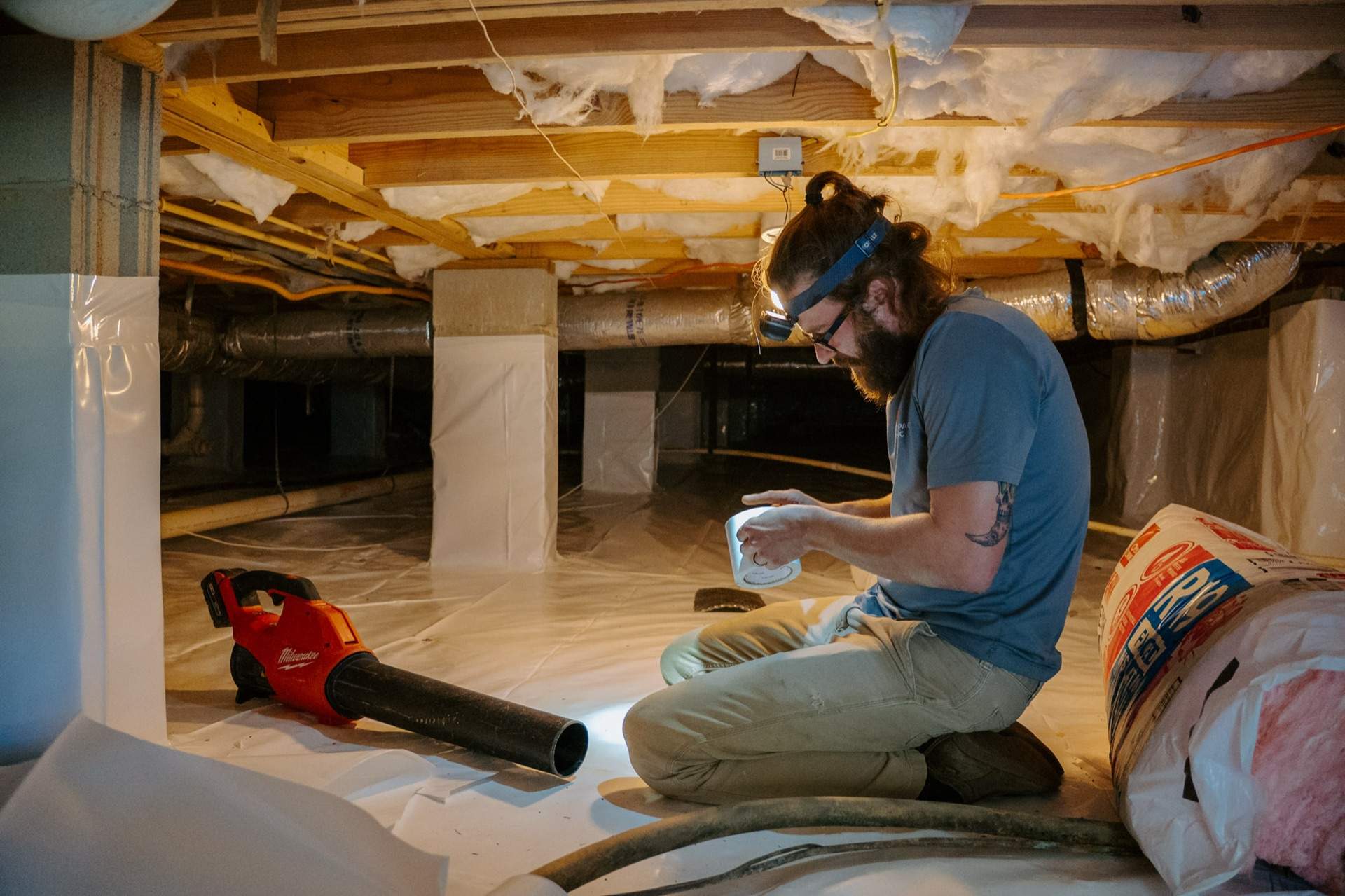
Moisture Control Under Your Home
Crawl Space Encapsulation
Seal the ground, close the vents, dry the air. Our free, photo-documented inspection tells you exactly what your crawl space needs, and what it doesn't.
Book a Free Inspection
A specialist will call you back to schedule.
The Problem
Your Crawl Space Sweats All Summer
By July, the space under your house is doing something you'd never allow upstairs. Warm, humid air pours in through open foundation vents, meets your cold air-conditioning ducts, and condenses on them, the way a glass of sweet tea sweats on a porch rail. Our crews see it in market after market: "We go into crawl spaces during the summer and come out dripping with water because the ductwork is sweating so badly from the humidity," is how one operator describes it, and teams in at least eight of our markets report the same seasonal pattern.
That water doesn't drain away. It soaks your insulation, raises the moisture content of the wood holding your house up, and feeds fungal growth on joists and subfloor. High wood moisture readings and high humidity are the most common findings our inspectors record nationally; ~85% of Crawlspace Medic's outgoing work is moisture-related. If your floors feel clammy, the house smells musty, or the summer power bill keeps climbing, the crawl space is the first place to look.
What It Is
What Crawl Space Encapsulation Actually Means
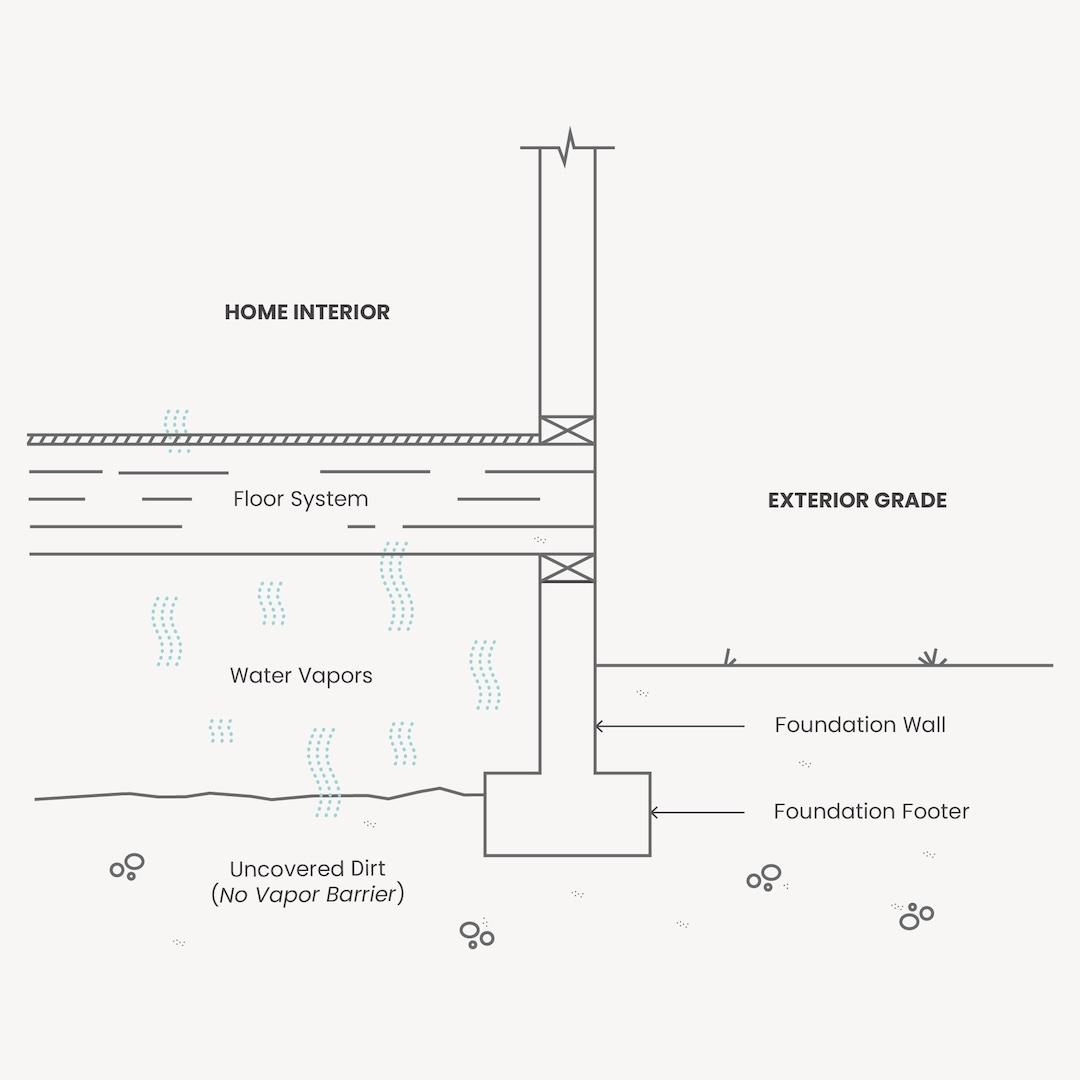
Encapsulation means controlling the environment under your house the same way you control the environment above it, starting with humidity. Three components do the work: a vapor barrier covering the entire ground, sealed foundation vents, and a dehumidifier sized to the space.
“Either you control the environment or Mother Nature controls the environment. And when you let Mother Nature control the environment, she doesn't do a very good job.”
Each component answers a different moisture source. The barrier stops ground moisture from evaporating into the air your framing lives above. Sealed vents stop humid outdoor air from replacing what the barrier blocked. The dehumidifier handles whatever's left, all year, without you thinking about it. If you'd like the full plain-English explainer before you talk to anyone, read What Is Crawl Space Encapsulation?
Warning Signs
Five Signs Your Crawl Space Needs Encapsulation
These five signs all point to the same condition: crawl space humidity your house can't shed on its own.
You don't need to see all five. Any one of them is reason enough to have the space looked at, and our inspection costs you nothing.
- You live in a hot, humid climate
- Condensation drips from your HVAC ducts
- Fungal growth is visible on joists or subfloor
- Floors upstairs are buckling or cupping
- Floor insulation has fallen or is sagging
The Honest Part
Why the Plastic Your Builder Installed Isn't Enough
Builder-grade 6-mil plastic on the ground is a code minimum, not a moisture solution. "Folks get an idea that all they really need is plastic on the ground, because it's what home builders put in. It's all they're required to put in," as one of our operators explains. Crews in at least seven of our markets routinely find that sheet bunched, wrinkled, untaped, and unstaked, and the wrinkles themselves trap pockets of moisture against the ground. A code minimum is a starting line. It was never designed to control the environment under your home.
Component 1
Vapor Barriers: The Standard We Install To
Here's why the barrier matters so much. Without proper ground coverage, framing lumber acts like a sponge: it absorbs moisture from the air, its moisture content climbs, surface fungal growth follows, and eventually the flooring system, subfloor, and sills rot.
Our barrier lineup is consistent across the network: 10-mil premium vapor barrier poly as the workhorse entry, 12–16-mil reinforced in the mid-range, and 20-mil premium material, matched to your crawl space's conditions and traffic rather than upsold by default. Code minimum is 6-mil; our floor is above it. Material warranties on premium vapor barriers are lifetime.
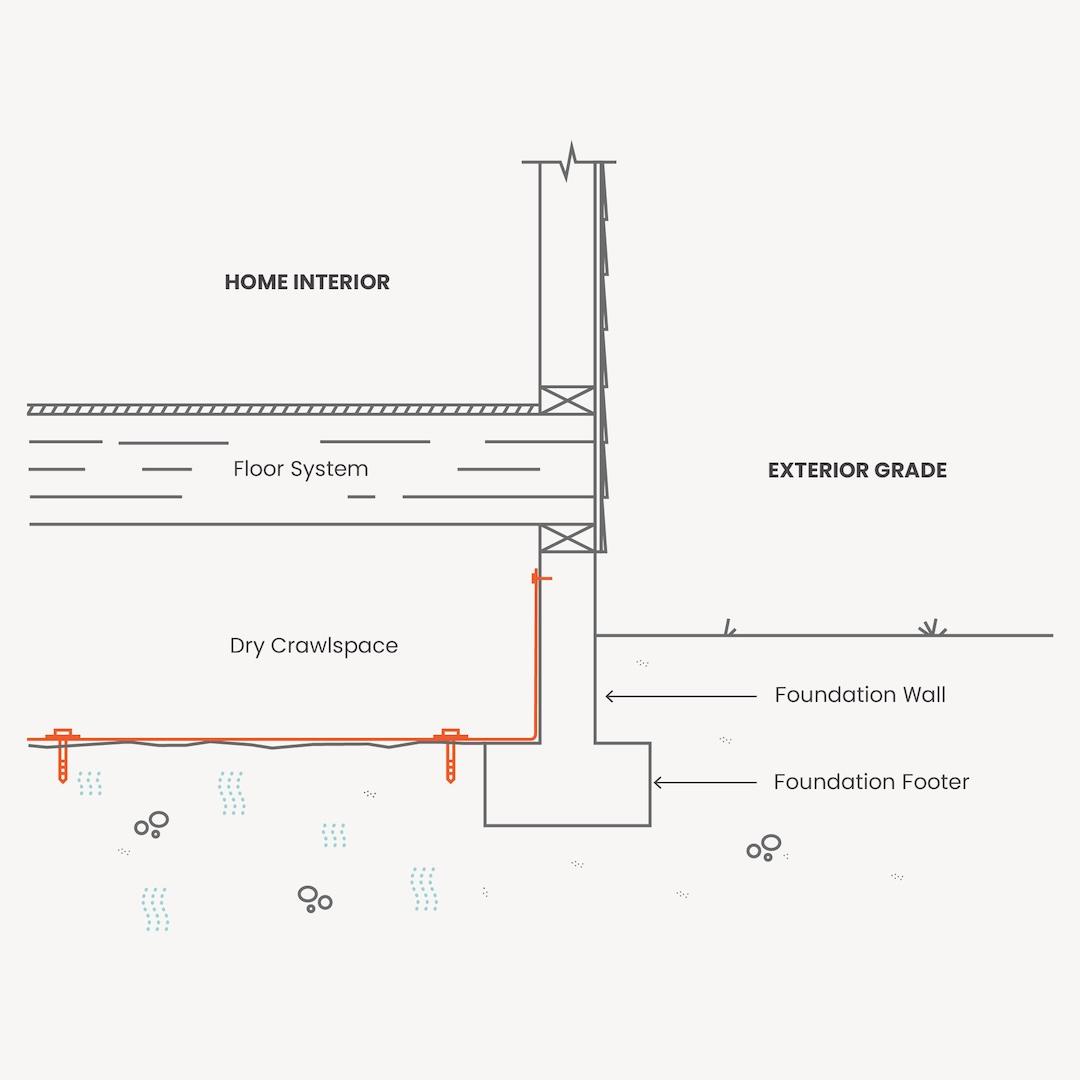
Installation is where a barrier earns its keep. We install heavy-gauge white polyethylene with every seam taped, held with poly ground spikes, cut tight around piers, built to survive the plumbers and HVAC techs who'll crawl through after us.
“Our goal is always to get 100% coverage on all of our barriers.”
One rule before any barrier goes down: if your crawl space takes on standing water, drainage comes first. That work is covered under crawl space waterproofing.
Component 2
Dehumidifiers: Sized to the Space, Serviced by Us
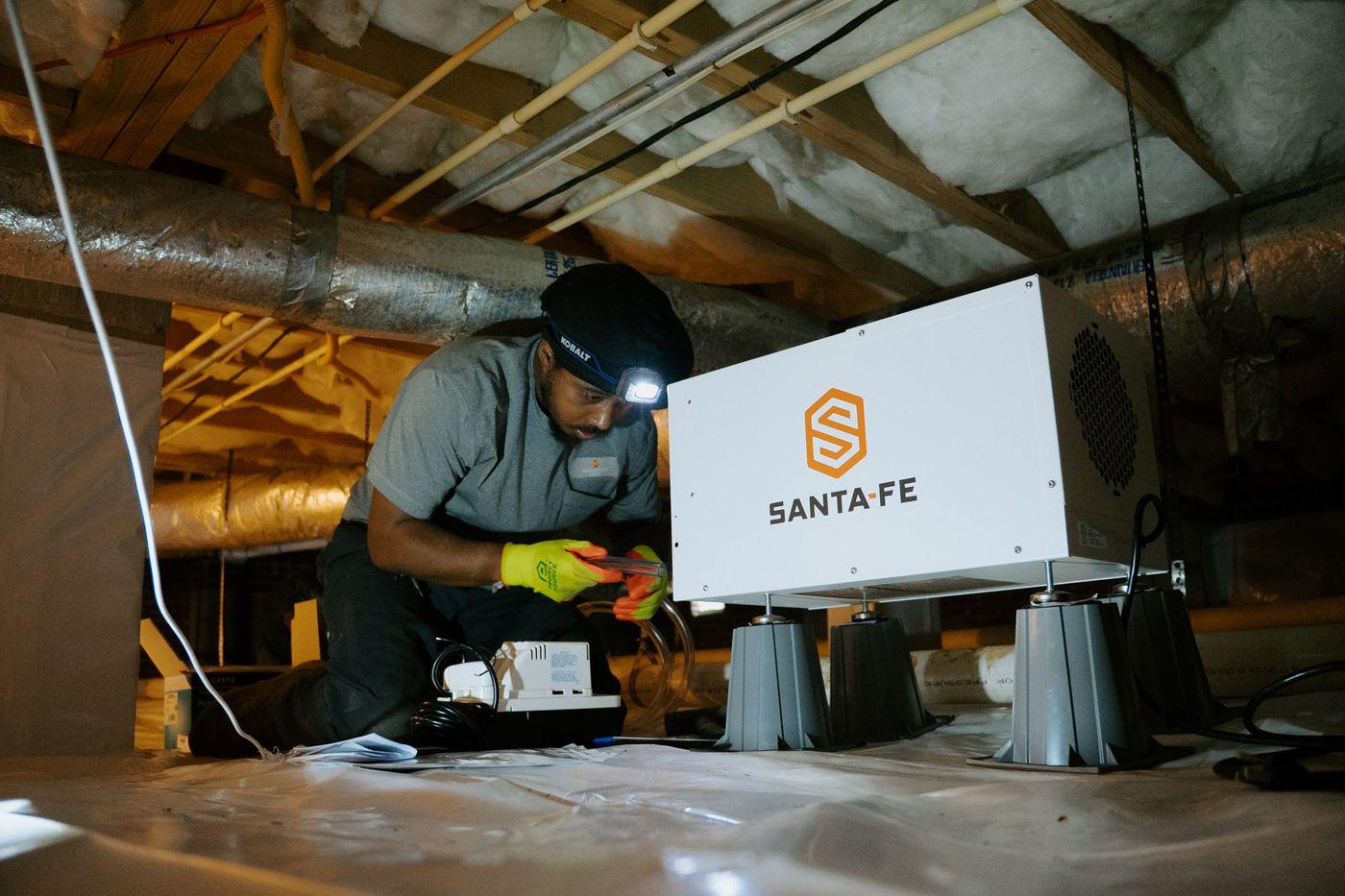
Santa Fe dehumidifiers are our network standard, named by our operators; and they're "our bread and butter." A Compact 70 handles spaces under roughly 1,500 square feet, and the Oasis 105-pint unit takes larger footprints. Each carries a six-year manufacturer warranty, and our crews service warranty replacements directly so you never have to deal with the manufacturer yourself. Aprilaire is our accepted secondary brand.
Component 3
Insulation That Belongs in a Sealed Crawl Space
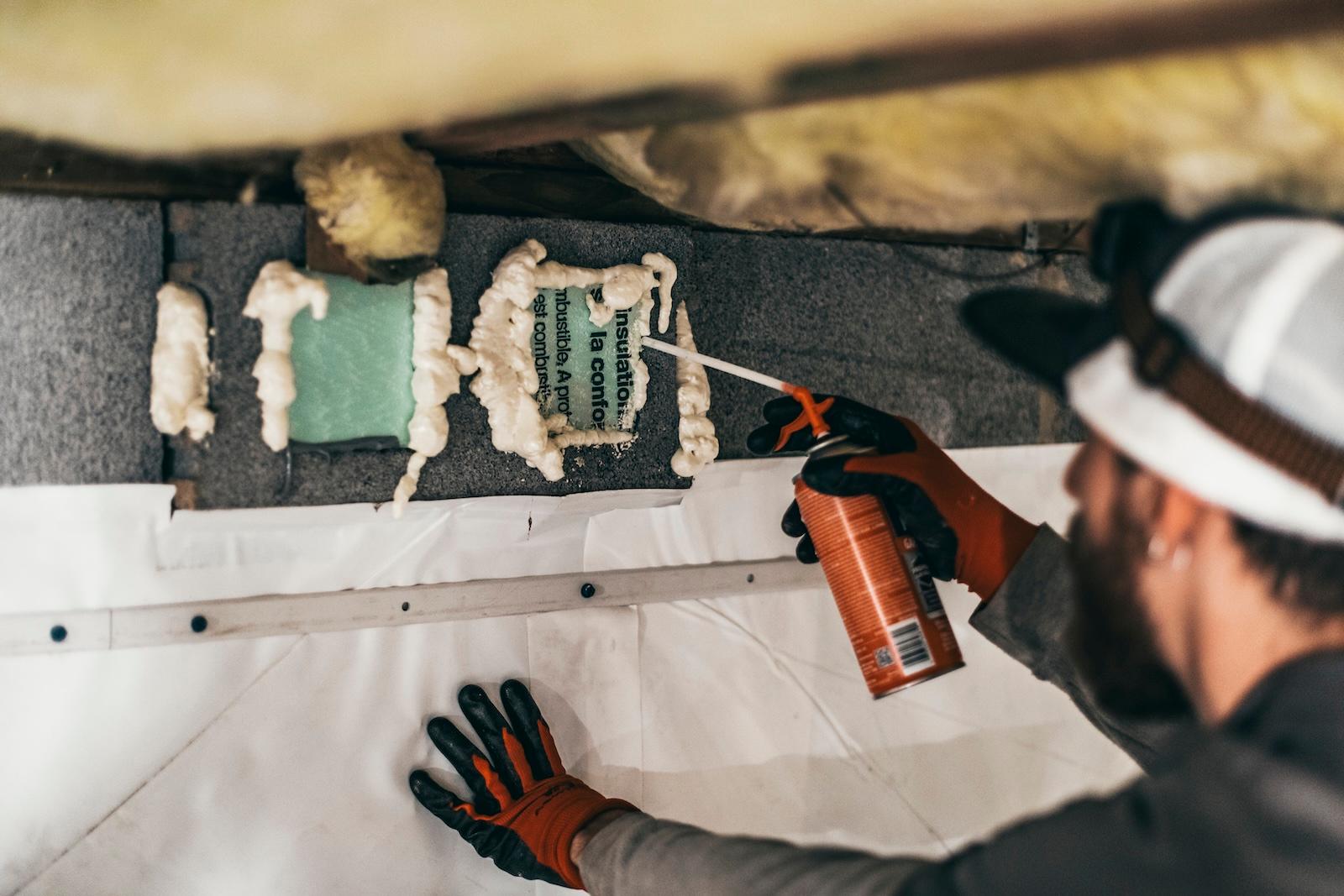
Traditional R19 fiberglass between the floor joists is cheap and warm on day one. In a damp crawl space, though, it absorbs moisture, falls, and molds; it makes ideal nesting material for rodents; and it hides your framing, so leaks and termite damage go unseen until they're much worse.
In a sealed crawl space we insulate the perimeter block walls instead: one inch of closed-cell spray foam, which delivers comparable R-value to floor insulation while leaving your framing visible, or roughly 2-inch foil-faced foam board. Installers leave a 6-inch termite-inspection gap between framing and insulation so pest inspectors can still see the perimeter wall. Closed-cell foam may also qualify for a federal tax credit of up to $1,200.
Component 4
Vent Sealing: Why Closed Beats Open
Open foundation vents were long believed to help moisture escape. In reality they let humid air in and make the problem worse, which is why modern building science recommends sealing; sealed crawl spaces perform better in hot climates and cold ones. The full open-versus-closed story, including where the old advice came from, is in Crawl Space Vents: Open or Closed?
The Payoff
What a Sealed Crawl Space Does for the Rooms Above It
Air moves through your house from bottom to top. As warm air rises and escapes high in the structure, replacement air gets drawn up from the crawl space, so a damp crawl space feeds the air you breathe upstairs. Musty smells, cold floors, and stuffy air are the giveaways. In a home with a vented crawl space, roughly 40% of first-floor air originated down there; sealing cuts that to under 6%. For the science, read Understanding the Stack Effect.
Sealing also pays a measurable energy return. Department of Energy field research puts heating and cooling savings above 15% per year for sealed crawl spaces. Your HVAC stops fighting a humid, house-sized room it was never designed to condition.
Budget Honesty
You Don't Have to Do It All at Once
A full encapsulation isn't the only honest option, and we'd rather phase your project than have you ignore the problem. A hybrid encapsulation runs the barrier 8–16 inches up the wall and seals everything except full wall and pier wrapping. As our Savannah operator puts it: "The dehumidifier is the secret sauce. But you can't put a dehumidifier in there without doing some type of sealing."
Phased work is standard practice across our markets: vapor barrier first, humidity re-checked, encapsulation completed later. One operator broke a project into three phases when no one else had been willing to do that. "It's not $20,000 or don't address the issue — there is an in-between."
Pricing
What Crawl Space Encapsulation Costs
Full moisture-control projects, drainage plus encapsulation, typically land between about $5,000 and $13,000 depending on footprint and scope. Operators across our markets report average project tickets of $6,000–$9,000, with smaller footprints starting near $4,500. The inspection sets the scope; there is no flat price list.
Many fixes are smaller than you fear. Across 8,000+ invoiced jobs in our network records, the median is under $1,000: typical component medians run about $680 for fungal treatment, $321 for a vapor barrier line, $899 for a sump pump, $972 for insulation, and $1,722 for a dehumidifier. The inspection that sets your project's scope is free, and inspections never appear as a billed line item anywhere in our 25,000+ invoice lines.
What Homeowners Say
Customer Reviews, in their words.

“We contracted Crawlspace Medic to encapsulate our crawlspace and install dehumidifier and remove debris from under house. We were very pleased with the end results and found them to be knowledgeable, courteous, and attentive to detail. Much thanks to Wayne and Walker, extremely pleasant to work with.”
“They saved us from the horrible smell infesting our newly purchased home. They were quick to get us on the books. They also communicated throughly throughout the process. William and Dewayne did such a wonderful job. They took around 65 massive bags of debris from under the house. They were professional, friendly, fast, and did an all-around wonderful job. The dehumidifier was much needed addition. Having our crawlspace encapsulated was the best money we have spent. I highly recommend the professionals at Crawlspace Medic.”
“Crawlspace Medic performed a full crawlspace encapsulation with sump pump and dehumidifier install. I am very pleased with the work performed and the crew who did the job. They were courteous, punctual and made sure they cleaned up the job site at the end of each day. I would highly recommend them to anyone.”
Common Questions
Questions homeowners ask.
How much does crawl space encapsulation cost?
Full projects that combine drainage and encapsulation typically land between about $5,000 and $13,000 depending on footprint and scope; operator-reported averages run $6,000–$9,000, and smaller footprints start near $4,500. The inspection sets the scope; there is no flat price list. Many jobs are far smaller: across 8,000+ invoiced jobs, the median is under $1,000. The inspection itself is free.
How long does an encapsulation last?
We'd rather answer with what we can put in writing. Material warranties on premium vapor barriers are lifetime. Santa Fe dehumidifiers carry a six-year manufacturer warranty that our crews service directly. Our workmanship carries a one-year warranty. And annual maintenance plans are a popular choice: homeowners keep us coming back to check sealed crawl spaces year after year.
Do my foundation vents really need to be closed?
Yes. Open vents were long believed to help moisture escape; in practice they let humid air in and make the problem worse. Sealed crawl spaces perform better in both hot and cold climates, which is why modern building science recommends sealing. Closing vents is one of the three encapsulation components.
What if the full project isn't in my budget right now?
You have real options. A hybrid encapsulation runs the barrier 8–16 inches up the wall and seals everything except full wall and pier wrapping. We also phase work: vapor barrier first, humidity re-checked, encapsulation completed later. As one operator puts it: "It's not $20,000 or don't address the issue — there is an in-between."
Will encapsulation lower my energy bills?
Department of Energy field research shows sealed crawl spaces saving more than 15% per year on heating and cooling. The mechanism is air movement: with a vented crawl space, roughly 40% of first-floor air comes from below, and sealing cuts that to under 6%, so your HVAC conditions less humid air.
My builder already put plastic on the ground. Isn't that the same thing?
No. Builder-grade 6-mil plastic is a code minimum, and our crews routinely find it bunched, wrinkled, untaped, and unstaked, with the wrinkles trapping moisture pockets. Encapsulation controls the whole environment: full ground coverage with a sealed barrier, closed vents, and a dehumidifier.
Do you oversell work?
We install solutions rather than systems. Operators in ten of our markets independently describe refusing one-size-fits-all packages, itemizing proposals, and letting evidence drive every recommendation: "If I'm going to suggest a repair, there's going to be evidence to back it up." They also document walking away from work you don't need, including a clean crawl space reading 14% moisture after a competitor's scare photos. "I don't need to sell you something you don't need." We also stay in our lane. Crawlspace Medic does not do push piers, helical piers, slab leveling, slab repair, foundation crack injection, or foundation underpinning. If your inspection points to that kind of structural foundation work, we'll say so plainly and refer you to a specialist who does it. Our work stays under your floor framing: moisture control, wood repair, and supplemental supports on footings and piers.
30+ Markets Across 11 States
Find your local crew.
Every Crawlspace Medic market is a local crew held to the same inspect-first standard. Find the office nearest you.
Find Your LocationStart With a Free Crawl Space Inspection
A photo-documented crawl of your full crawl space, moisture readings included, with findings explained in plain English. No charge, no obligation. Crawlspace Medic serves over 30 locations across 11 states, each locally owned and operated by people who live in the communities they serve.