
The place every fix starts
Crawl Space Inspection: Free, Photo-Documented, No Pressure
You can't make a good decision about your crawl space until someone shows you what's actually down there. We photograph everything, explain it in plain language, and the inspection costs you nothing.
Book a Free Inspection
A specialist will call you back to schedule.
Why homeowners call
You've noticed something. Now find out what it means.
A musty smell that won't air out. A soft spot in the hallway. A home inspector's one-line note about "moisture observed." Something under your house is telling you it needs attention, and guessing at the cause from upstairs doesn't work. Most homeowners never go into their own crawl space, so problems get months or years of head start before anyone looks.
Across our national network, elevated wood moisture content and high humidity are the most common findings our inspectors document. One local operator estimates 85% of the work he performs is moisture-related. That matters for you in one specific way: moisture problems announce themselves in small signals long before they become structural ones. An inspection reads those signals early, while the fix is still simple (and cheap!).
What to expect
What a photo-documented crawl space inspection covers
Our inspection isn't a glance through the access door. It's a documented walk of your full crawl space or basement, and it follows the same sequence in every market.
First, a lap around the outside of the house: grading, gutters, downspouts, vents, and anything steering water toward the foundation. Then the inspector goes under the home and works through it with a camera: moisture readings in the wood, the condition of your floor structure, insulation, the vapor barrier, and any evidence of pests. Every finding gets photographed where it sits.
When the crawl is done, you get a walkthrough of the photos and readings, with recommendations built for your house and your budget. "We do not believe in a one-size-fits-all approach… no two houses are the same." You'll see what the inspector saw, not a summary you have to take on faith.
Some of what we find is seasonal, and experience matters for reading it. In summer, warm humid air entering a vented crawl space meets cold HVAC ducts and condenses. "We go into crawl spaces during the summer and come out dripping with water because the ductwork is sweating so badly from the humidity." A dripping duct in July and a dry crawl space in January can be the same problem. An inspector who has crawled hundreds of these spaces knows which findings are the condition and which are the symptom.

The numbers behind the verdict
How we measure: the wood moisture content scale
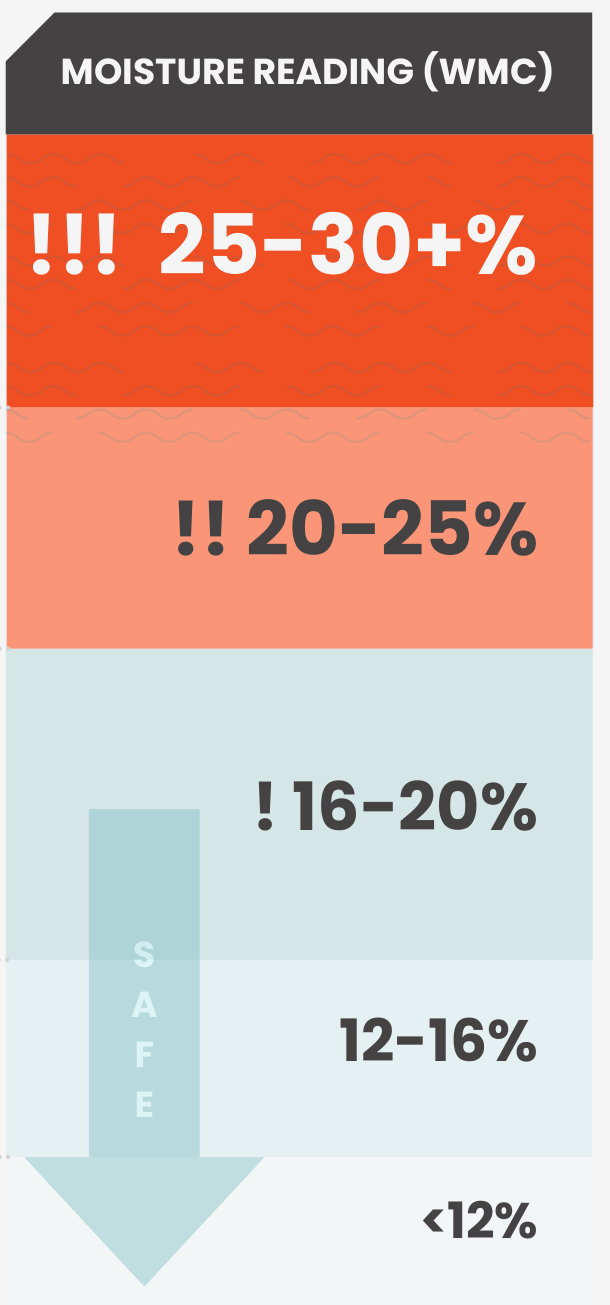
Moisture readings are the backbone of the inspection. Using a pin-type moisture meter, the inspector takes six or seven readings across your joists, subfloor, beams, and sills, then reads them against a scale drawn from Clemson Extension data.
| Wood moisture reading | What it means for your home |
|---|---|
| 12–16% | Healthy. Wood at a safe moisture level. |
| 16–20% | Possibly elevated. Find the moisture source. |
| 20–25% | Serious. Correct the problem immediately. |
| 25–30% | Extensive damage, such as dry rot and mold, is often evident. |
This is why the walkthrough isn't a sales conversation. A number is a number. If your joists read 14%, you'll hear that they're healthy. If they read 22%, you'll see the reading taken in front of you and understand why it can't wait. For a deeper explanation of what the readings mean, our guide to acceptable wood moisture levels walks through the full scale.
Your pre-call checklist
7 crawl space warning signs you can check yourself
You don't need a meter to know it's time to call. These are the seven warning signs we teach homeowners to check:
- Standing water or damp soil under the house
- A musty smell indoors
- Visible mold or mildew
- Sagging or bouncy floors
- High humidity or condensation
- Damaged or fallen insulation
- Pest or rodent evidence
"If there's a problem down there, it will show up in the rest of your home." That musty smell in particular is the single most common reason homeowners across our markets pick up the phone, and it's a real data point, not a nuisance. Air moves from the crawl space up into your living space, which is why what's under the house never stays under the house. Our stack effect guide explains the science.
Buying or selling a home
A home inspection is not a crawl space inspection
Here's the gap that surprises buyers: a general home inspection doesn't go as deep under the house as you'd assume. General inspectors don't necessarily see what a crawl space specialist sees.
We do this work every day, on deadline. Across our markets, agents call with due diligence ending the next day, repair letters in hand, and deals on the line. "An agent will call and say: due diligence ends tomorrow… That probably happens daily or weekly." Several of our markets put real-estate work at 40–75% of their business. If your transaction has a crawl space question in it, you won't be our first this week.
Buying a Home
Have the crawl space itself inspected before you close.
Selling a Home
Inspect before you list. Moisture findings surfacing late can delay a closing and cut your price.
The honest part
Sometimes the answer is "you're fine," and we say so
An inspection is only worth something if "no problem found" is a possible outcome. Ours is. Our local operators across the Crawlspace Medicnetwork document walking away from work that isn't needed: a crawl space reading a clean 14% after another company's scare photos, with the homeowner told "I don't need to sell you something you don't need." A homeowner told "you're good" after a big-chain pitch. A structural engineer confirming a customer needed nothing at all. "She cried when we told her."
That's not generosity. It's the standard the recommendation has to meet: "If I'm going to suggest a repair, there's going to be evidence to back it up."
After the inspection
You keep the report. What happens next is up to you.
When the walkthrough ends, the photos, readings, and findings are yours to keep, whether or not you hire us for anything. If work is warranted, you'll get an itemized proposal tied to the evidence in your report, because we install solutions rather than systems: no bundled packages, no one-size-fits-all quote. Take it, compare it, sit on it. The house isn't going anywhere, and neither is the report.
If the findings point to a specific fix, these pages explain how we approach each one: crawl space repair for damaged framing, crawl space waterproofing for water intrusion, crawl space encapsulation for humidity control, and basement waterproofing where the space under your home is a basement instead.
The cost
How much does a crawl space inspection cost? Nothing.
Free inspections are our standard across the Crawlspace Medic network. That's not a promotion, and it's not a teaser with a fee hiding behind it. In 25,000+ invoice line items across our markets, an inspection never appears as a billed charge. Not once. The inspection is how we scope work honestly; charging for it would work against the point.
Free also means a second opinion costs you nothing. Operators across our network routinely land the same scope of work at a third to a half of large-competitor quotes, with documented examples: $45,000 quoted elsewhere done for $19,000, a $61,000 quote pared to a $15,000 plan. If you're holding a big quote from someone else, have us under the house before you sign it. Either we confirm the quote is fair, or you just saved a great deal of money for the price of a phone call.
Timing
When should you schedule a crawl space inspection?
Sooner beats later, and the calendar has a say. Our busy season runs nationally from roughly March or April through October, driven by humidity and rain; one of our markets has seen September come in as its biggest month five years running. If you've spotted one of the seven warning signs, don't wait for the season to make it obvious. A reading of 17% found early is a hunt for the source of the moisture. The same crawl space left alone can become a costly repair.
What Homeowners Say
Customer Reviews, in their words.

“Jake did an inspection on one of the homes I am purchasing with a new buyer and he was on time, efficient and was able to explain everything very clearly with photos and drawings. Very thorough! Highly recommend.! Thank you, Jake!”
“I called Crawlspace Medic to come out to do an inspection of sagging floors in our kitchen. The company was extremely responsive and has great communication. Tram was super helpful in evaluation of our situation, took pictures and gave us photos and clear explanation of what the damage is and what they would recommend. Very honest and professional.”
“I highly recommend Keith. He's very professional and his thorough inspection exceeded my expectations. Very satisfied from start to finish.”
Common Questions
Questions homeowners ask.
How much does a crawl space inspection cost?
It's free, everywhere in our network. Inspections don't appear as a billed line item anywhere in 25,000+ invoice lines across our markets, so there's no fee waiting at the end of the visit.
What does the inspector actually check?
The full sequence: a lap around the house outside, then moisture readings, floor structure, insulation, vapor barrier, and pest evidence under the home, all photo-documented, followed by a walkthrough of findings and recommendations fitted to your house and budget.
What's a healthy wood moisture reading?
12–16% is healthy. 16–20% is possibly elevated and means the moisture source should be found. 20–25% is serious and needs immediate correction. At 25–30%, extensive damage such as dry rot and mold is often evident. Readings are taken with a pin-type meter in your joists, subfloor, beams, and sills.
The house I'm buying already had a home inspection. Do I need this too?
Yes. A general home inspection is not a crawl space inspection, and general inspectors don't necessarily see what a crawl space specialist sees. We work real-estate deadlines constantly, including next-day due diligence calls, so a tight timeline isn't a problem.
My house is new. Can I skip the crawl space?
New construction isn't immune. Our operators report fungal growth within six months in new homes, homes rained on during construction carrying staining, and new development changing how water flows into existing crawl spaces.
Will the inspection turn into a sales pitch?
No. Recommendations have to carry evidence: "If I'm going to suggest a repair, there's going to be evidence to back it up." And when nothing's wrong, we say you're fine and leave, which our operators across the network document doing all the time.
What makes a Crawlspace Medic inspection honest?
An honest inspection includes being honest about what we don't do. If your inspector finds a problem that calls for push piers, helical piers, slab leveling, or foundation crack injection, we'll tell you plainly, because that's not Crawlspace Medic work, and we'll point you toward the right kind of specialist. What we do is the work under your floor: moisture control, drainage, encapsulation, and floor-framing repair with supplemental supports. You'll never hear us stretch a finding to fit a service we sell.
Crawl space inspection near me
Local inspectors across 11 states
Crawlspace Medic operates over 30 locations across 11 states, each locally owned and operated by people who live in the communities they serve, from the Carolinas and Georgia through Tennessee, Alabama, Kentucky, Virginia, Indiana, Ohio, Missouri, and Arkansas. The inspector who crawls your home works your area every week and knows what your local soil and climate do to crawl spaces. Homeowners across the network have left 6,164+ verified public Google reviews averaging 4.9 stars.
Find Your LocationFind out what's really under your house
Free, photo-documented, and explained in plain language. You keep the report whether you choose us or not.