Structural repair, honestly scoped
Crawl Space Repair That Starts With Why the Wood Failed
Bouncy floors and sagging spans have a cause under the house. We find it, fix the framing, and correct the moisture that damaged it, so the repair holds.
Book a Free Inspection
A specialist will call you back to schedule.
The symptom upstairs
Your floors are telling you something failed below
The floor bounces when you cross the living room. There's a dip near the kitchen island, or a slope you've started stepping around without thinking about it. Sagging or bouncy floors are one of the seven warning signs we teach homeowners to check, and of the seven, they're the one that means wood is already giving way.
Here's the science, because you should know the why before anyone quotes you a fix: Without a proper ground barrier, the framing wood under your home acts like a sponge. It absorbs moisture straight from the air, its moisture content climbs, surface fungal growth takes hold, and eventually the flooring system, subfloor, and sills rot. Nationally, elevated wood moisture and humidity are the most common findings our inspectors document. Floors rarely fail from age alone. They fail from staying wet.
What repair covers
The floor framing under your home, piece by piece
Crawl space repair is work on the wooden structure your floors stand on. Sills sit on the foundation and carry the frame. Joists span between supports and hold up the subfloor. The subfloor is the deck your finished flooring is fastened to. Girders and band boards tie the system together. Damage to any one of them shows upstairs as bounce, sag, or slope.
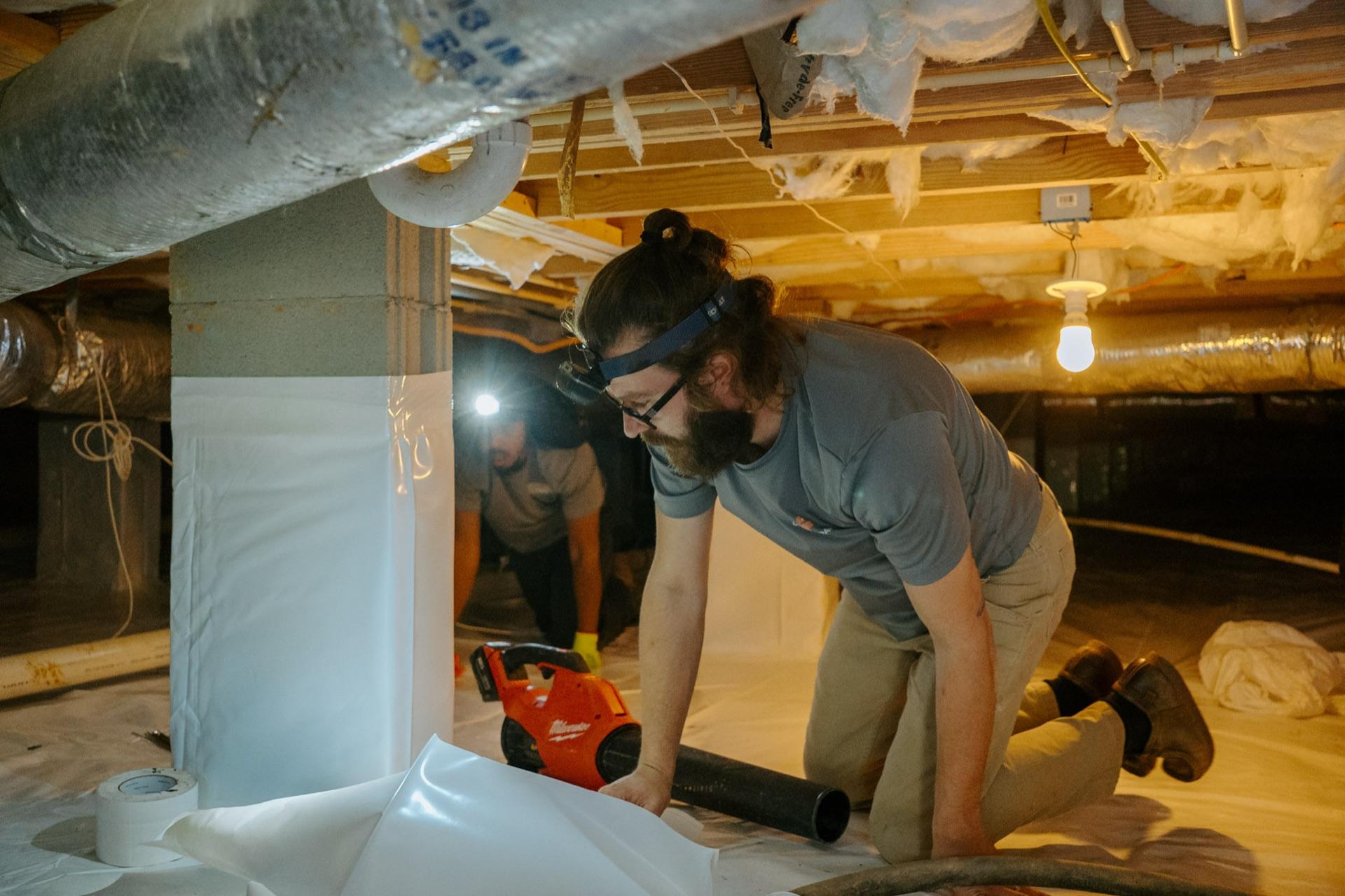
Our repair process is engineered per-home, not pulled from a package. Our crews set temporary supports to hold the structure while they work, cut out damaged sills and joists, and replace them with pressure-treated lumber. Where a joist is weakened but intact, we sister a new joist alongside it. Girders and band boards get replaced where they've failed. Then permanent supplemental supports go in where the structure needs them: adjustable steel supports in some of our markets, poured footings with masonry piers in others. The method is geared towards your home.
Dry rot
Dry rot: moisture damage wearing a misleading name
Despite the name, dry rot is moisture-driven fungal decay. The fix isn't just cutting out crumbling wood; it's correcting the moisture that fed the fungus, or the new lumber goes the same way. That's why our rot repairs get scoped together with moisture control, and why a repair quote that never mentions moisture should worry you. Sponge-like moisture absorption through unprotected framing is the usual root cause.
The invoice record across our network backs this up. Fungal treatment, anti-fungal fogging and surface treatment, is the single most common line item in 25,000+ invoice lines, and it's typically paired with moisture control for a plain reason: treatment without fixing the moisture is temporary. When we quote a rot repair, expect the moisture fix in the same conversation.
Termite damage
Termite damage: treat the insects first, then rebuild
Termite damage and wood rot look similar under a flashlight, but they need different fixes. Termites are insects; look for mud tubes on the foundation. Rot is fungus. "Guessing wrong can cost you thousands." When it's termites, pest control comes first: the colony has to be treated before repair makes sense, and then we rebuild the damaged framing behind them. If you're not sure which one you're looking at, our guide to termite damage vs. wood rot shows how to tell them apart.
Framing repairs
Joist, sill, and girder repairs
Framing repair is the core of our repair services: replacing rotted sills, cutting out and replacing failed joists, sistering weakened ones, and rebuilding girders and band boards with pressure-treated lumber, with temporary supports carrying the load while the work happens. Every repair is scoped from inspection evidence, member by member. You'll see photos of each piece of wood we propose to touch and the reading or damage that justifies it.
Masonry, posts, and piers
Supplemental supports: footings and piers under floor framing
Where spans are long or loads have grown, framing needs more support points than it was built with. We add them: adjustable steel supports in some markets, poured concrete footings with masonry block piers in others, each set under the girders and joists they're meant to carry. This is masonry post and pier work under floor framing, engineered per-home. It's the right tool when floors have deflected because the wood between supports is doing too much work. It is not foundation underpinning, and when a home needs that, we say so and refer out.
Water damage
Water-damaged framing: fix the water or repeat the repair
Water in a crawl space is not normal, and framing that's been standing over it will keep degrading until the water is handled. The common causes are knowable: poor yard drainage, clogged gutters or short downspouts, high groundwater, plumbing or HVAC leaks, and a missing vapor barrier. Most of it starts outside. Rain percolates down and becomes groundwater, and because the crawl space usually sits lower than the surrounding grade, that groundwater presses on the block perimeter and seeps through it, between footing and wall, or under the footing and back up. When we repair water-damaged wood, we scope the water fix alongside it, which usually means crawl space waterproofing for liquid water and crawl space encapsulation for the humidity that follows it. Repairing the wood while leaving the water is a repair you'll buy twice.

Older homes
Homes from the 1800s and early 1900s are a specialty, not a problem
Old houses are a recurring national specialty for us. Homes from the 1800s and early 1900s sit on original foundations with long joist spans that were never designed for modern remodel loads, like stone countertops and added second stories. The answer is engineered supplemental supports sized to the new loads, and in historic districts our crews have matched period lumber so the repair belongs to the house. If your home predates your great-grandparents, it doesn't need replacing. It needs someone who's worked under its kind before.
Second opinions welcome
We fix other contractors' repairs more often than we'd like
"It often surprises us how many jobs we have to fix someone else's poor repair work." Undersized supports, unaddressed moisture, wood spliced without carrying the load anywhere. If you've had repair work done and the symptoms came back, that's worth a free inspection before it's worth a worry. And if the previous work is holding fine, we'll tell you that too.
The cost
What crawl space repair honestly costs
Two honest numbers frame it. Standalone single services are modest: across 8,000+ invoiced jobs in our network, the median job is under $1,000. Full moisture-control projects, drainage plus encapsulation, typically land between about $5,000 and $13,000 depending on footprint and scope. Major structural or water rebuilds run roughly $20,000–$80,000, and they're the exception, not the norm: only a handful of jobs in our invoice export have ever exceeded $15,000.
There's no flat price list, and you should be suspicious of anyone who has one. The inspection sets the scope. That's also why phasing is normal here: it's not "$20,000 or don't address the issue." There is an in-between, and we regularly break projects into stages to fit a budget.
If you already have a repair quote from a larger outfit, get a second look before you sign. Operators across our network routinely land the same scope of work at a third to a half of large-competitor quotes: $45,000 quoted elsewhere done for $19,000, quotes of $50,000–$60,000 done near $20,000. The inspection sets the scope either way, and ours is free.
Standing behind it
A warranty you won't have to chase
A one-year workmanship warranty is standard on our repairs. And when installed equipment carries a manufacturer warranty, our crews handle the warranty service directly, so you're never stuck on the phone with a manufacturer over a part we installed.
What Homeowners Say
Customer Reviews, in their words.

“Professional job repairing and resupporting floor joists. Consultant/estimator (Cameron) provided photos and drawings and listened well to our needs. Expert installers (Vinny and Malachi) worked quietly and efficiently. All were very respectful of Person, Property and Time! Excellent communication. Very competitive price. On time start (earlier than first planned) and completed as predicted! Could not have asked for better! Highly recommended!”
“Crawlspace Medic did an incredible job with major repairs to our home's joists and subflooring. Kevin was thorough and informative with the estimate and Nathan and his team were polite, professional, knowledgeable and went the extra mile to be sure the job was done well. The whole team made the experience top notch.”
“Max and his team at Crawlspace Medic did an awesome job replacing my rotted wood joists. Super professional and honest throughout the process. Highly recommend them for structural repair work in the crawl space.”
Common Questions
Questions homeowners ask.
How much does crawl space repair cost?
Median single-service jobs across our 8,000+ job invoice record come in under $1,000; full moisture-control projects typically run about $5,000–$13,000; major structural rebuilds of roughly $20,000–$80,000 are rare exceptions. The inspection sets the scope, so the honest answer for your house comes after we've been under it.
Can sagging floors be fixed without replacing the joists?
Often, yes. Where a joist is weakened but structurally intact, our crews sister a new pressure-treated joist alongside it rather than cutting it out. Full replacement is for members that have actually failed. The inspection photos determine which is which, member by member.
How do I know if it's termite damage or wood rot?
Termites leave mud tubes and need pest control before any repair; rot is moisture-driven fungal decay and needs moisture control. They look similar, and "guessing wrong can cost you thousands," so we identify before we quote.
Will you repair work another company did badly?
Yes, and it's more common than you'd hope: "It often surprises us how many jobs we have to fix someone else's poor repair work." Start with a free inspection so we're correcting from evidence, not assumptions.
My house was built in the 1800s. Can it actually be repaired?
Yes. Original-foundation homes with long joist spans are a recurring specialty across our markets. They typically need engineered supplemental supports for modern loads, and in historic districts we've matched period lumber.
Where do I start?
With a free crawl space inspection. It's photo-documented, it never appears as a billed line item, and it produces the evidence any honest repair scope has to stand on.
What is the scope of crawl space repair?
Be clear on where our repair scope ends. Supplemental supports under your floor framing, adjustable steel supports, and footings and piers under girders and joists are our work. Push piers, helical piers, slab leveling, and foundation crack injection are not. Those belong to full-service foundation contractors, and if your home needs them, we'll tell you at the inspection and refer you out rather than stretch our scope to keep the job. Our recommendations carry evidence or they don't get made.
Crawl space repair near me
Repair crews working in over 30 locations across 11 states
Crawlspace Medic operates over 30 locations across 11 states, each locally owned and operated by people who live in the communities they serve, from the Carolinas and Georgia through Tennessee, Alabama, Kentucky, Virginia, Indiana, Ohio, Missouri, and Arkansas. The network’s invoice export records 7,846 completed jobs across those markets, so the crew under your house has seen your kind of framing problem before.
Find Your LocationGet the crawl space repair scoped from evidence, not fear
A free, photo-documented inspection tells you what failed, why, and what it honestly takes to fix. Schedule your free inspection online or call us today.